

When I was a student, there was a popular book among my classmates called Zuo Wen Da Quan (The Complete Guide to Essays). The idea was simple: memorize the sentences inside, piece them together, and you’d have a good essay — because that book was the standard. It led to some funny moments. One classmate wrote about “helping my parents work in the rice fields,” but we all grew up in the city. He had never even seen a rice field.
That image has stayed with me — not because it was funny, but because it points to something very common. When the goal becomes “write a sentence that scores well,” students abandon their own thoughts and imitate a model answer. The sentence looks polished, but the expression is hollow.
We kept thinking about this while designing the Sentence Maker feature in Turtle Teach.
The feature recently went live. Teachers can set different requirements based on grade level — specifying keywords, theme, sentence pattern, writing technique, or rhetorical device. But what we spent the most time on was not the configuration options. It was what students see after they submit.
We broke the feedback into three parts: comments, rating, and hints.
Comments are delivered by a cartoon character called “Proffy,” who acts as a learning companion. We deliberately made the tone feel like a patient friend rather than a red-pen correction report — first acknowledging what the student did well, then pointing out what could be improved, and finally encouraging them to try again.
Rating uses five stars instead of a hundred-point scale. Under a hundred-point system, every single point feels significant — the gap between 80 and 84 is difficult for students and parents to ignore. With five stars, both scores fall within the four-star range, and the small difference is intentionally blurred. What students see is not a precise number but a general direction: roughly where they are, and where they can go next.
Hints adjust based on how close the student is to meeting the requirements. If the sentence is still far off, the system provides a more complete example sentence as reference. If it mostly meets the requirements, the system encourages the student to try constructing another sentence based on a different scenario.
Here is an example from testing.
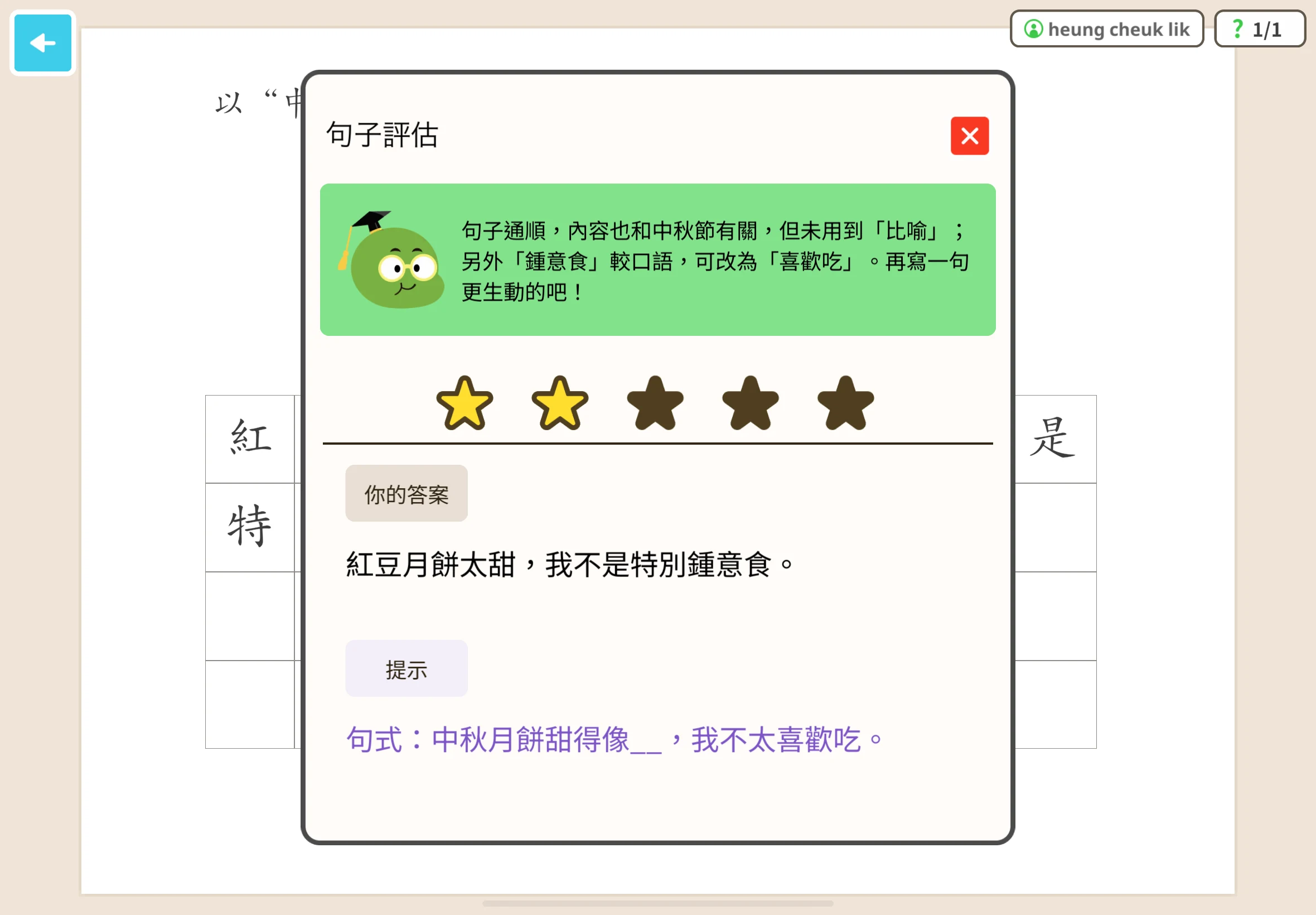
The requirement is: “Write a sentence about the Mid-Autumn Festival using a metaphor.” A student writes: “Red bean mooncakes are too sweet — I don’t really like to eat them. (紅豆月餅太甜,我不是特別鍾意食。)” The sentence carries genuine personal feeling, but it does not include a metaphor.
In this case, the feedback does not simply say “No metaphor used. Points deducted.” Instead, it first recognizes that the student expressed a real opinion about the Mid-Autumn Festival, then points out that a metaphor has not been used yet, and encourages the student to think: what could the sweetness of a mooncake be compared to? The hint offers a nearly complete example sentence where the student only needs to come up with the comparison themselves.
Some might think this is too lenient. The comments read like encouragement letters, the hints give away too much — is this really a serious assessment of sentence-making ability?
But we would rather ask a different question: what counts as a “good sentence”? In our view, a sentence that reflects the student’s own thinking, comes from their own life, and stays true to their own voice is already a good sentence. It might have imperfect punctuation or a missing rhetorical device — but those things can be improved through practice. The last thing we want is a student who, after receiving a low score and harsh feedback, develops a fear of writing — or worse, learns to only write “safe, high-scoring” sentences and gives up on genuine expression.
We would rather students treat this tool as a space for experimentation. Write about something from everyday life, read the feedback, check the hint. Two stars this time, three stars next time — that is progress.
I recently watched the film Sentimental Value. There is a scene near the beginning that left a strong impression. The lead character is a stage actress. Minutes before the curtain goes up, she keeps saying she is not ready, that she does not want to go on. She even tears her costume. Her colleagues patch it back together with tape. She goes on stage anyway.
Most of the audience probably cares about the ending: did the performance fall apart, or did she pull it off? But what I care about more are those few minutes before. Saying “I’m not ready” is not something to be ashamed of. Going on stage in a costume held together with tape is not something to be ashamed of. Stepping out there and finishing the performance in her own way — that alone is worth encouraging.
Sentence-making is the same. Not being ready is fine. Write something down first, then adjust. What matters is not producing a perfect sentence on the first try, but being willing to keep trying.