
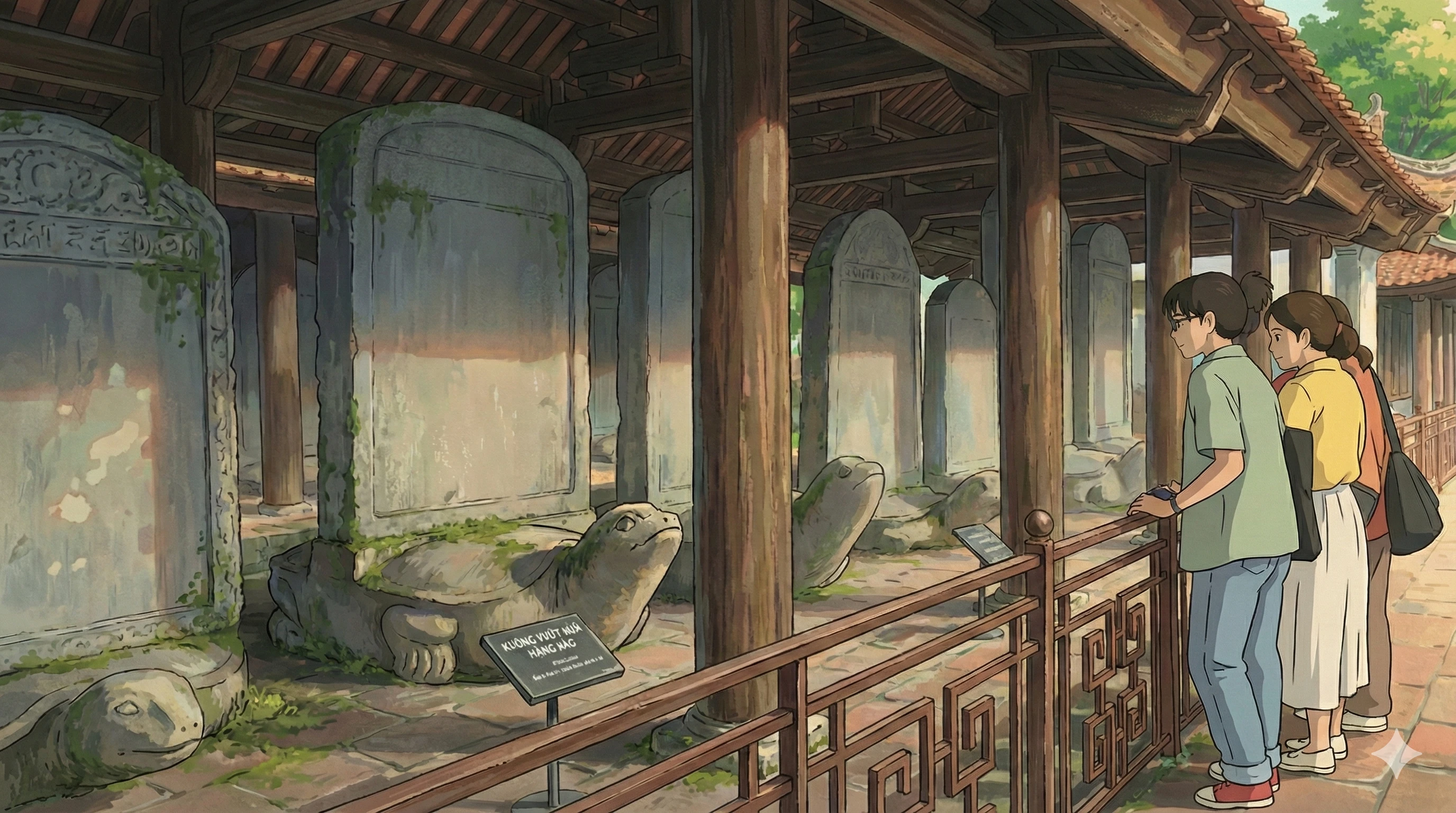
Walking through the courtyards of Văn Miếu - Quốc Tử Giám in Hanoi, it is easy to miss the quiet power of the place.
There are no classrooms in use anymore. No students reciting texts. No officials administering exams.
Yet lined up in the courtyards are rows of stone turtles, each carrying a stele engraved with names - scholars who passed imperial examinations centuries ago.
These stones are not relics of vanity.
They are evidence of an idea that once shaped entire societies - and still does.
That idea is the imperial examination system, known in China as 科舉制度 / 科举制度.
A Precise Moment in Time: 1070 CE, Not an Accident
The Temple of Literature (文廟/ 文庙/Văn Miếu) was founded in 1070 CE, during Vietnam’s Lý Dynasty - a period when the Vietnamese court was actively consolidating state institutions and cultural identity.
This timing matters.
In China, the year 1070 falls squarely within the Northern Song dynasty (北宋), under Emperor Shenzong (宋神宗) - an era when the 科舉制度 / 科举制度 had already matured into the backbone of imperial governance.
By this point in Chinese history:
- The examination system was fully institutionalized
- Confucian classics were standardized as state ideology
- Scholar-officials, not aristocrats, dominated the bureaucracy
Vietnam was not adopting an untested model. It was adopting a battle-tested governance system at its historical peak.
Just six years later, in 1076, Vietnam formally established the Imperial Academy (國子監/国子监 / Quốc Tử Giám) adjacent to the temple - completing the transformation of Văn Miếu from a ritual Confucian site into a functioning national university.
Seen this way, Văn Miếu is not merely inspired by China’s system. It is Vietnam’s synchronized entry into the East Asian Confucian meritocratic world order.
A Shared Examination DNA
China’s imperial examination system was not merely a way to test knowledge. It was a state-building mechanism.
Instead of granting power by birth or military force, the system attempted something radical for its time:
- Select officials through mastery of texts
- Legitimize authority through moral learning
- Create a ruling class defined by education rather than lineage
Vietnam, while politically independent, adopted this model with intention.
At Văn Miếu, the Imperial Academy (Quốc Tử Giám) trained scholars in:
- Confucian classics
- Moral philosophy
- History and governance
- Classical Chinese writing
Vietnamese candidates sat for examinations structured almost identically to China’s multi-tier system - provincial, metropolitan, and palace-level exams - with the highest achievers entering government service.
This reflected a conscious decision to adopt a proven governance model.
For a state living alongside a larger neighbour, Confucian meritocracy offered a way to build legitimacy, stability, and administrative competence.
Why Names Were Carved on Stone Turtles
The most striking feature of Văn Miếu is its stone stelae resting on turtle backs.
The symbolism matters.
In East Asian tradition:
- Turtles represent longevity and endurance
- Stone represents permanence
- Public inscription represents state recognition
These monuments recorded:
- The year of the examination
- The reigning emperor
- The names and hometowns of successful scholars
They were not personal trophies. They were public proof that merit could transcend family background.
In contrast to European aristocratic systems, where lineage and land defined status, East Asian societies embedded a different promise: Learn long enough, endure hardship, and the state will recognize you.
That promise, even when imperfectly fulfilled, carried immense psychological weight.
Exams as Social Elevators - and Social Contracts
For centuries, examinations functioned as social elevators.
Passing an exam meant:
- Lifting one’s entire family’s status
- Securing stable income and prestige
- Gaining moral authority in society
Failure, however, was personal and absolute.
This created a social contract:
- The state promised fairness through standardized testing
- Individuals accepted extreme pressure in exchange for opportunity
The system was harsh, exclusionary, and exhausting. But it was widely perceived as fairer than birthright.
That perception matters more than the reality.
The Long Shadow in Modern East Asia
Fast forward to today.
Across Vietnam, China, Korea, Japan, Singapore, and beyond, familiar patterns persist:
- High-stakes entrance exams
- Parental anxiety
- Academic rankings tied to personal worth
Why has this culture proven so resilient?
Because examinations in East Asia were never just assessment tools. They became moral sorting mechanisms.
Success signaled discipline, endurance, and virtue. Failure implied personal deficiency - not systemic mismatch.
Even when modern economies no longer require exam-trained bureaucrats, the psychology remains.
Why Exam Reform Is So Difficult
Educational reformers often propose:
- Holistic assessment
- Creativity-based evaluation
- Project and portfolio learning
Yet resistance is strong.
Why?
Because exams feel:
- Objective
- Scalable
- Culturally legitimate
Alternatives feel subjective, risky, and potentially unfair.
You can dismantle the structure, but the belief system lingers.
Reading the Turtles Today
The stone turtles at Văn Miếu no longer determine careers. But they still tell a story.
They remind us that:
- Education was once society’s main mobility engine
- Endurance was treated as virtue
- Assessment carried moral weight
The challenge today is not to abandon merit - but to redefine it.
Can we preserve fairness without trauma? Can assessment measure growth, not just rank? Can learning honor diversity of ability without erasing standards?
Those questions are still waiting - quietly - in the courtyards of Hanoi.
The Northern Song dynasty (960–1127) is often regarded by historians as the period in which China’s civil service examination system reached full institutional maturity.